
How Body Weight Affects Knee and Hip Joints: A Guide for Noida Residents
By Dr. Anuj Jain, Orthopaedic Surgeon (M.B.B.S., M.S. Orth, D.N.B.), Dr. Anuj Jain Clinic, Sector 50, Noida | Published: 15 October 2026
If your knees ache after climbing stairs or your hips feel stiff after a short walk, your body weight may be part of the reason. Understanding how body weight affects knee and hip joints is one of the most useful steps towards protecting your mobility. As an orthopaedic surgeon practising in Noida, I regularly meet people in their thirties, forties and fifties who are surprised by how much extra load their joints carry with every step.
How Much Load Do Your Knees and Hips Carry?
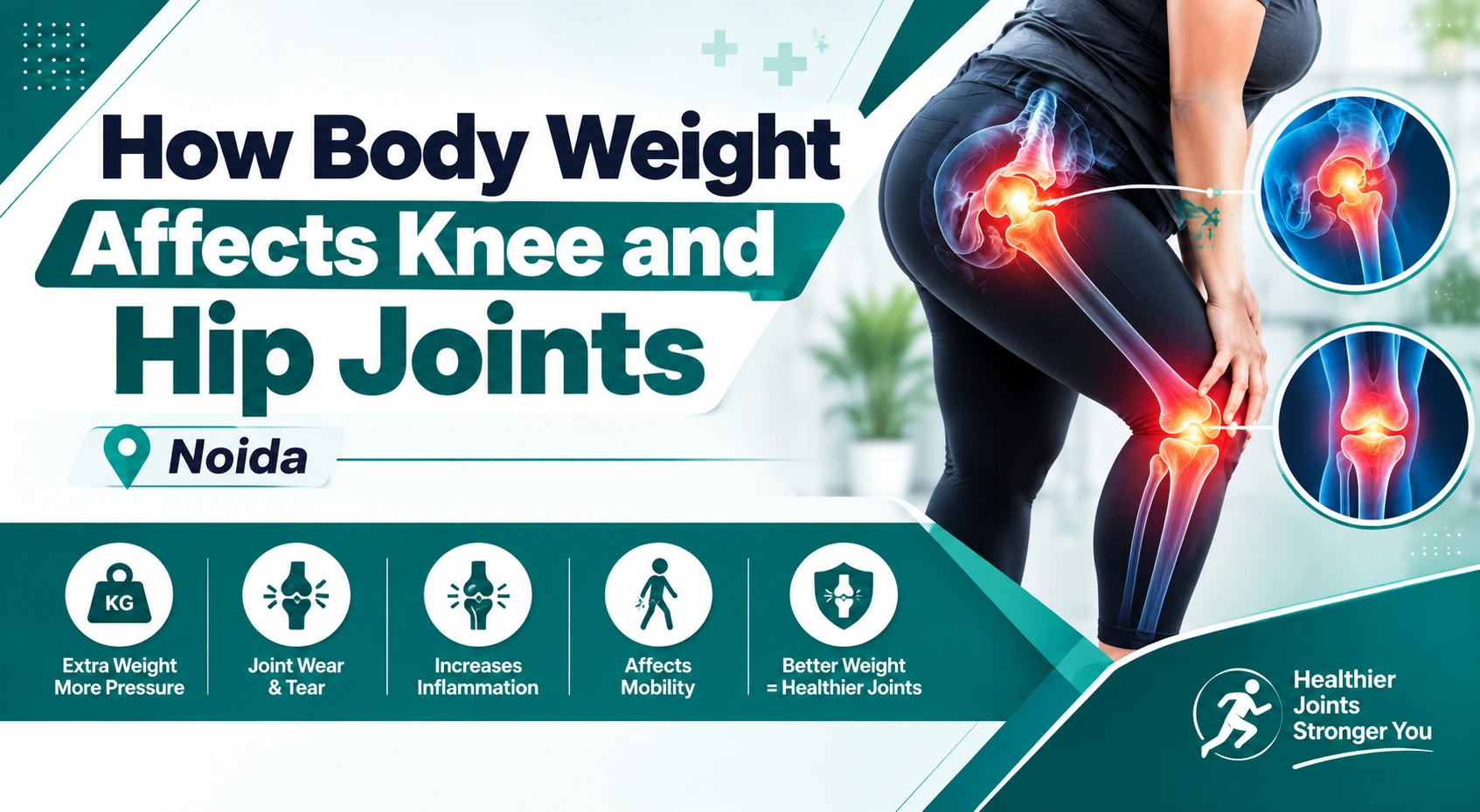
Your knees and hips are weight-bearing joints. While you walk, the force passing through them is several times your body weight. Research shows that every extra kilogram of body weight adds roughly four kilograms of load on the knee with each step. A person carrying 10 kg of excess weight therefore places about 40 kg of additional force on each knee while walking. Repeated thousands of times a day, this stress gradually wears down the smooth cartilage that cushions the joint.
Obesity and Joint Pain: More Than Mechanical Pressure
The link between obesity and joint pain is not only about load. Body fat is metabolically active and releases inflammatory chemicals that can irritate joint tissues. This may explain why people with higher body weight can develop pain earlier and more severely. Excess weight also often travels with diabetes and high blood pressure, which can affect joint health and healing.
Knee Osteoarthritis and Body Weight
Knee osteoarthritis is the joint condition most strongly linked to excess weight. As cartilage thins, the bones lose their smooth gliding surface, causing pain, stiffness and swelling. Higher body weight raises the risk of developing arthritis and can speed up its progression. The hip is affected too, although the association is less pronounced than in the knee.
Common warning signs include:
- Pain while climbing stairs or rising from a chair
- Morning stiffness or stiffness after sitting for long
- Swelling or a grinding feeling in the knee
- Groin or thigh pain with a limp, which may point to the hip
A Note on Body Weight for Indians
Health risks begin at lower body weights in Asian Indians. Indian consensus guidelines consider a BMI of 23 to 24.9 as overweight and 25 or above as obese, and they highlight waist circumference as an important marker.
Weight Loss for Knee Pain: Small Changes Matter
The encouraging part is that weight loss for knee pain works. Studies show that losing about 5 to 10 percent of body weight can reduce pain and improve function in people with knee osteoarthritis, particularly when diet and exercise are combined. Clinical guidelines, including those of the American College of Rheumatology and the Arthritis Foundation, recommend weight loss for overweight patients with knee or hip osteoarthritis.
Practical Steps to Protect Your Joints
A structured approach to joint pain management usually begins with these lifestyle measures:
- Aim for gradual, steady weight loss through a balanced diet rather than crash diets.
- Choose low-impact activity such as walking on even ground, cycling and swimming. Our guide to joint-friendly exercises explains safe options.
- Strengthen your thigh and hip muscles, which act as natural shock absorbers.
- Include adequate protein, calcium and vitamin D, and consider checking your vitamin D level, as deficiency is common in India.
Staying Active with Joint Pain in Noida
Many residents dealing with joint pain in Noida spend long hours commuting or working at desks, leaving little time for exercise. Short, regular walks in a nearby sector park, and indoor cycling or swimming on high-pollution days in winter, are realistic ways to stay active.
When Should You See a Doctor?
Consult a registered orthopaedic doctor if joint pain lasts more than a few weeks, wakes you at night, causes swelling or a limp, or limits your daily activities. Most people are first advised nonsurgical measures such as weight management, physiotherapy and medication. Surgery, such as total knee replacement, is considered only when joint damage is advanced and other measures no longer provide relief.
Frequently Asked Questions
Does being overweight always cause knee pain?
No. Weight is one risk factor among several, including age, previous injury, genetics and activity level. However, extra weight increases both load and inflammation in the joint, which raises the likelihood of pain.
Key Takeaway
How body weight affects knee and hip joints comes down to load and inflammation. Every kilogram counts, and even modest weight loss can ease pain and slow wear. If joint pain is affecting your routine, speak to a qualified doctor for an assessment suited to you.
This article is for general awareness and is not a substitute for personal medical advice.
References
- Messier SP, et al. Weight loss reduces knee-joint loads in overweight and obese older adults with knee osteoarthritis. Arthritis & Rheumatism. 2005;52(7):2026–2032.
- Messier SP, et al. Effects of intensive diet and exercise on knee joint loads, inflammation, and clinical outcomes among overweight and obese adults with knee osteoarthritis: the IDEA randomized clinical trial. JAMA. 2013;310(12):1263–1273.
- Kolasinski SL, et al. 2019 American College of Rheumatology/Arthritis Foundation Guideline for the Management of Osteoarthritis of the Hand, Hip, and Knee. Arthritis Care & Research. 2020;72(2):149–162.
- Misra A, et al. Consensus statement for diagnosis of obesity, abdominal obesity and the metabolic syndrome for Asian Indians. Journal of the Association of Physicians of India. 2009;57:163–170.
Clinic Details
Dr. Anuj Jain Clinic, Basement, A-12A, Block A, Sector 50, Noida, UP – 201301
Phone: +91 88002 17857 | Email: jain.doctor.anuj@gmail.com

Useful Links
Our Services
Dr. Anuj Jain
 "Being an Orthopaedic Surgeons my aim is restoring mobility and keeping our nation in motion."Dr. Anuj JainM.B.B.S., M.S. (Orth), D.N.B. Gold Medalist